
Family-owned and protecting Raleigh-area homes since 1964. A board-certified entomologist on staff and termite plans built around how Raleigh homes are actually put together.
Termites are the quietest problem a Raleigh house can have. Unlike a wasp nest or a mouse in the pantry, an Eastern subterranean termite colony works entirely out of sight — inside a crawl space sill plate, behind a slab expansion joint, up through a mulch bed that touches the siding. Most Raleigh homeowners find out the same two ways: a spring swarm of winged insects against a sunny window, or a home inspector's flashlight during a sale. Clegg's Pest Control has been handling termites for North Carolina families from our headquarters on Bastion Lane in Raleigh since 1964, and we're rated 4.8 out of 5 stars across thousands of NC reviews.
Wake County is squarely in Eastern subterranean termite country, and Raleigh's mix of Piedmont clay soil, mature hardwood shade, and a housing stock split between old crawl-space bungalows and newer slab-on-grade subdivisions gives termites more than one way in. A Clegg's termite solutions plan starts with a free inspection of the whole structure — crawl space, foundation line, and the conditions around it — and ends with a treatment built for how your specific house is put together. No two Raleigh foundations are the same, and the treatment shouldn't be either.
- Licensed & insured local technicians
- Board-certified entomologist on staff
- Pet- and family-safe treatments
- Free inspection within 24 hours
What Raleigh Homeowners Say About Clegg's
Why Raleigh Homes Are at High Risk for Termites
Subterranean termites need two things to thrive: cellulose to eat and a constant supply of moisture. Raleigh supplies both generously. The city sits on Piedmont uplands where the dominant soils are Cecil-series red clay — North Carolina's official state soil — and while clay drains adequately on a slope, it moves water slowly and holds it against foundations in the flat, graded spots where houses actually sit. Add a humid subtropical summer and the mature oak and willow-oak canopy that shades so much of Raleigh, and the soil along a foundation line stays damp far longer here than it would in sandier parts of the state.
The species doing the damage is almost always the Eastern subterranean termite (Reticulitermes flavipes), which is native and widespread across the Piedmont. The Formosan subterranean termite gets a lot of headlines in the Southeast, but in North Carolina it has only been confirmed in a small number of locations — Brunswick and Rutherford counties — and it is not established in Wake County. That's genuinely good news for Raleigh: you're dealing with a well-understood native insect with well-established treatment methods, not an exotic emergency. What it does mean is that a colony takes roughly three to five years to mature before it produces the winged swarmers most people notice, so by the time you see a swarm, the colony has already been feeding somewhere nearby for years.
Where Termites Enter Raleigh Homes
Subterranean termites live in the soil and travel up into a structure through any point where wood meets ground, or through mud tubes they build across masonry to bridge the gap. On Raleigh properties, the same handful of entry points show up over and over. Most of them are things a homeowner can see from the yard.
Soil-to-Wood Contact
Deck posts, porch steps, lattice skirting, and fence rails set straight into the ground give termites a direct, hidden path from soil into structural wood.
Crawl Space Piers & Sills
The classic entry route in older Raleigh bungalows. Mud tubes climb brick piers to reach sill plates, joists, and subfloor above.
Mulch Beds Against Siding
Deep hardwood mulch piled to the siding holds moisture and hides the foundation line, so tubes go unnoticed for seasons at a time.
Slab Joints & Penetrations
Concrete slabs crack and separate at construction joints. Plumbing and conduit penetrations open the same hairline route up into framing.
Firewood & Lumber Piles
Firewood stacked against the house or scrap lumber left under a deck is a food source parked right at the foundation. Store it off the ground and away.
Clogged Gutters & Downspouts
Raleigh's hardwood canopy fills gutters fast. Overflow saturates the soil at the foundation and keeps the wood above it damp year-round.
Stumps & Buried Wood
Old stumps, buried form boards, and construction debris left in the backfill feed a colony quietly until it works its way toward the house.
HVAC Condensate Lines
Condensate discharging next to the foundation during a Raleigh summer creates a permanently damp spot — exactly the conditions termites look for.
Termite Risk by Raleigh Property Type
How your house was built matters more than where it sits. A 1920s bungalow in Cameron Park and a 2015 build in Wakefield both have termite exposure, but the route in, the inspection method, and the treatment plan are genuinely different.
Crawl Space Homes Inside the Beltline
Raleigh's early planned suburbs — Boylan Heights platted in 1907, Cameron Park developed between 1910 and 1927, Hayes Barton in the 1920s — were built on brick piers over vented crawl spaces, the standard of the era. That's actually an advantage for inspection: a technician can get under the house and read the piers directly for mud tubes. The disadvantage is that a vented crawl space in Raleigh's humidity stays damp, and decades of settling, added HVAC ductwork, and retrofitted plumbing tend to leave low clearance and wet spots. NC State's guidance is to keep at least 18 inches between soil and wood so inspection stays possible at all. These homes usually need moisture work and termite treatment thought about together.
Slab-on-Grade Subdivisions in North Raleigh
Slab construction removes the crawl space, which removes the easiest place for a homeowner to spot early activity — and that's the problem. Termites reach framing through cracks and construction joints in the slab and through the gaps around plumbing and conduit penetrations, none of which are visible once flooring goes down. The first symptom is often cosmetic: paint that bubbles on a baseboard, a door casing that sounds hollow. Treating a slab home means drilling along joints and cracks to reach the soil underneath, per NCDA&CS post-construction standards, or installing a bait system around the exterior perimeter.
Creek- and Greenway-Adjacent Lots
Lots that back to Crabtree Creek, Walnut Creek, or the Neuse River corridor sit near floodplain soil that stays wet long after the rest of the neighborhood has dried out, and they're surrounded by fallen hardwood, stumps, and leaf litter — a standing food supply for colonies in the woods behind the fence line. Shade from the canopy keeps the north side of the house from ever drying properly. Homes in this position benefit most from grading and drainage attention alongside treatment, since the moisture pressure is continuous rather than seasonal. Moisture control is often the piece that makes the difference here.
New Construction on Disturbed Grade
Newly built homes aren't exempt, and owners are often surprised by that. Clearing and regrading a Raleigh lot buries stumps, roots, and leftover form lumber in the backfill, and compacted clay around a fresh foundation changes how water moves for the first several years. Pre-construction soil treatment is standard on new builds, but its coverage is not permanent, and landscaping installed afterward — irrigation lines, deep mulch, raised beds against the veneer — can undercut it. A three-to-five-year-old subdivision is exactly when a first independent inspection is worth doing.
Raleigh's Termite Season: What to Expect
Termites don't take the winter off — the colony lives below the frost line and keeps feeding year-round. What changes with the season is what you can see, and spring is when the house finally tells on itself.

Raleigh's Termite Specialists Since 1964
60+ years protecting NC homes. 250,000+ customers served. Free termite inspections — response within 24 hours.
Call (919) 231-0600 Schedule OnlineHow Clegg's Treats Termites in Raleigh
Termite work is structural work. It starts with understanding how your house meets the ground, and it isn't finished when the truck leaves. Here's what the process looks like on a Raleigh home from first visit to ongoing monitoring.

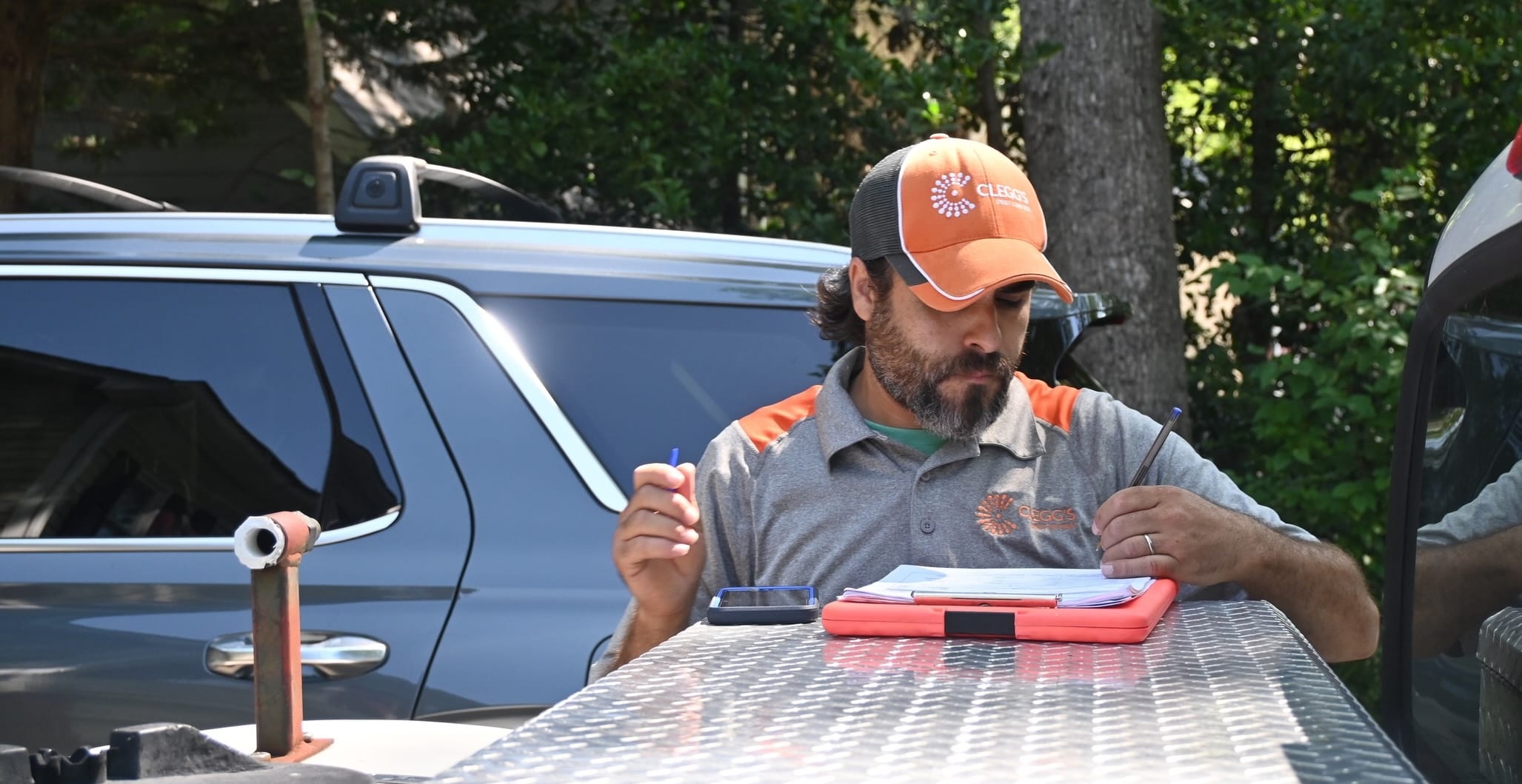
A Clegg's technician working a termite treatment at a Raleigh home.
Full Structural & Crawl Space Inspection
Your technician walks the exterior foundation line and, where there's a crawl space, goes under the house. We're reading piers and sill plates for mud tubes, sounding wood for hollow spots, checking for shed wings, and noting every conducive condition — soil-to-wood contact, low clearance, standing water, a leaking supply line. On slab homes we work the perimeter, expansion joints, plumbing penetrations, and interior trim. Findings are documented before anything is quoted.
A Treatment Plan Built for Your Foundation
There are two proven approaches, and the right one depends on your house. A liquid termiticide soil treatment establishes a treated zone in the soil around and beneath the structure. A bait station system is installed in the ground around the perimeter and works on the colony over time through regular monitoring. Some Raleigh homes are better served by one, some by a combination. Your technician explains the trade-offs for your specific foundation rather than selling one answer to everybody. More detail lives on our termite information page.
Targeted Application — Trenching, Rodding, and Drilling
Liquid work means trenching along the foundation and applying termiticide at the rate and depth set by state standards, rodding where needed, and drilling through slab, patio, or attached garage where the soil can't be reached from above. Holes are patched. On bait systems, stations are placed at measured intervals around the structure. Clegg's technicians are licensed through the NCDA&CS Structural Pest Control and Pesticides Division and work to its rules.
Every Raleigh Foundation Gets Its Own Plan
A brick-pier crawl space in Five Points and a slab in Brier Creek need different work. We document what we actually find at your address — clearance, drainage, entry points, existing damage — and build the treatment around it. Free inspection, no obligation.
Call (919) 231-0600Correcting the Conditions That Invited Them
Treatment addresses the colony; conducive conditions decide whether you're back here in five years. Where we find them, we'll flag and address the fixable ones — pulling mulch and soil back off the siding, extending downspouts, improving crawl space ventilation and vapor barrier, restoring clearance between soil and wood, redirecting HVAC condensate. In damp Raleigh crawl spaces this is often paired with moisture control, because dry wood is the cheapest termite protection there is.
Annual Renewal Inspections & Monitoring
No termite treatment is a one-and-done. NCDA&CS guidance is that thorough annual inspections should be performed to catch new activity, and bait systems need scheduled monitoring visits on top of that. Clegg's handles the recurring inspection schedule so it doesn't fall to you to remember. Coverage terms and renewal specifics vary by home and by treatment type — your technician will walk you through exactly what applies to yours at the inspection.
Raleigh Neighborhoods & Areas We Serve
Clegg's provides termite inspections and treatment across the City of Raleigh and surrounding Wake County, dispatched from our Raleigh office on Bastion Lane. Our technicians know which parts of the city are crawl space country and which are slab, because it changes how the inspection gets done.
FAQs About Termite Control in Raleigh
Get Your Raleigh Home Inspected for Termites
Free inspections. Crawl space and slab homes alike. WDIR reports for Raleigh real-estate closings. Call our Raleigh headquarters today.
Call (919) 231-0600 Schedule Online