
What Is the Japanese Beetle?
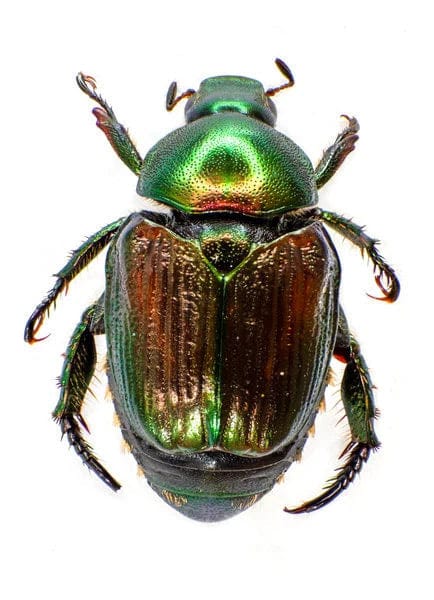
Japanese beetles (Popillia japonica) are a destructive invasive pest in North Carolina, attacking over 300 plant species. Adults are about 10 mm long with a metallic green head and thorax, copper-brown wing covers, and distinctive tufts of white hair along the sides of their abdomen.
Habitat & Behavior
Adult Japanese beetles emerge from the soil in late June through August and feed on the leaves, flowers, and fruit of roses, grapes, linden trees, crape myrtles, and many other ornamental and fruit plants. They eat the tissue between leaf veins, leaving a distinctive lace-like “skeletonized” pattern.
Japanese beetle grubs (larvae) live in soil and feed on grass roots from late summer through the following spring. Heavy grub infestations cause lawns to develop irregular brown patches that feel spongy and can be peeled back like carpet, revealing the white C-shaped grubs beneath.
Prevention & Control
Control targets both life stages. Grub treatments applied to lawns in late summer or early fall kill larvae before they cause significant root damage. Adult beetles can be hand-picked from plants or managed with targeted insecticide applications to protect high-value ornamentals. Avoid Japanese beetle traps near gardens—they attract far more beetles than they catch and can worsen damage to nearby plants.