
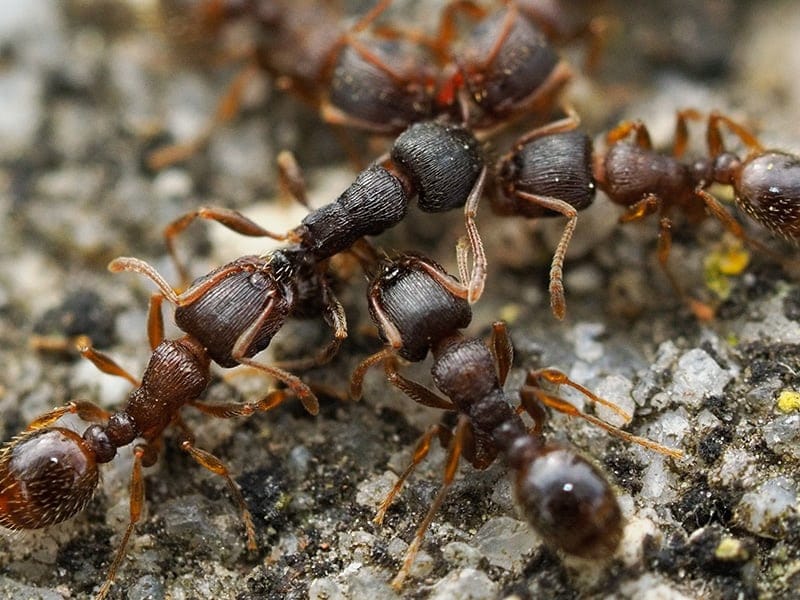
What Are Pavement Ants?
Pavement ants (Tetramorium immigrans) are one of the most common ant species in North Carolina. They are small (about 3 mm), dark brown to black, with parallel grooves on their head and thorax visible under magnification. They get their name from their habit of nesting under sidewalks, driveways, and building foundations.
Habitat & Behavior
Pavement ants create small mounds of displaced soil along cracks in pavement, at the edges of sidewalks, and around foundations. These sand-like piles are often the most visible sign of an infestation. Colonies contain a single queen and 3,000–5,000 workers.
These ants feed on a wide variety of foods including sweets, grease, seeds, bread, meats, and other insects. They commonly enter homes through cracks in slab foundations, expansion joints, and around plumbing penetrations, trailing along baseboards to reach kitchen and bathroom areas.
Prevention & Control
Pavement ants are known for their aggressive territorial behavior—ant wars between neighboring colonies are common in spring, producing large masses of fighting ants on sidewalks and driveways. Control involves baiting along active trails, treating cracks and expansion joints where ants enter, and sealing entry points. Reducing food sources by cleaning up crumbs and storing food in sealed containers discourages indoor foraging.