
Family-owned and protecting Greenville-area homes since 1964. A board-certified entomologist on staff and termite plans built around how Greenville homes are actually put together.
Termites are quiet tenants. They don't buzz, they don't bite, and by the time most Greenville homeowners notice them, the colony has usually been working on a sill plate or a floor joist for a while. Eastern North Carolina makes that easier for them than almost anywhere else in the state — flat ground, a shallow water table, and soils that stay damp long after the rain stops. Clegg's Pest Control has worked Pitt County out of our Greenville office on Rivit Street since 1964, and we're rated 4.8 out of 5 stars across thousands of North Carolina reviews.
Whether you own a 1940s crawl-space home near College View, a rental block off Charles Boulevard, or a newer slab house out toward Winterville, a Clegg's termite treatment plan starts with an inspection of the actual structure — not a script. Our technicians are licensed by the state, we've been doing this in eastern NC for six decades, and we'll tell you plainly whether what you're looking at is termite damage, old damage, or something else entirely.
- Licensed & insured local technicians
- Board-certified entomologist on staff
- Pet- and family-safe treatments
- Free inspection within 24 hours
What Greenville Homeowners Say About Clegg's
Why Greenville's Coastal Plain Is Hard on Homes
Subterranean termites need three things: wood, warmth, and steady soil moisture. Greenville hands them all three. Pitt County sits in North Carolina's Coastal Plain, where the soils formed from coastal and river sediments of sand, silt, and clay. Several of the county's most common soil series — Bladen, Coxville, Byars — are described by the county's own soil survey as poorly drained, nearly level soils with a seasonal high water table at or near the surface. Sandy loam on top lets termites tunnel easily; the dense clay and high water table underneath keep that tunnel network damp year-round.
Then there's the Tar River. It runs straight through the middle of Greenville, and its floodplain is flat enough that water spreads rather than drains. Flood stage at the Greenville gauge is 13 feet; during Hurricane Floyd in September 1999 the river crested at 29.74 feet — nearly 17 feet above flood stage and still the record. Hurricane Matthew pushed it back over 24 feet in October 2016, and Florence brought another round of eastern NC flooding in 2018. Homes that took water, and homes that simply sat in saturated ground for a week, often end up with crawl spaces that never fully dried out. Damp subfloor framing is exactly the condition that turns a passing termite foraging tube into an established infestation.
The dominant species here is the Eastern subterranean termite (Reticulitermes flavipes). NC State Extension notes that North Carolina has at least three native species of subterranean termites, and that swarming can begin in late winter and continue into September or October. That's a long window in a warm, wet county — which is why an annual inspection matters more here than it does in the mountains. You can read more about how termites behave in North Carolina in our pest library.
Where Termites Enter Greenville Homes
Subterranean termites come up from the soil. They either find wood touching the ground or build shelter tubes across masonry to reach it. Here's where our Greenville technicians find them most often:
Soil-to-Wood Contact
Deck posts, porch steps, lattice skirting, and siding buried by years of settled grade. The single most common conducive condition we write up in Pitt County.
Damp Crawl Spaces
With the water table sitting close to the surface, crawl-space soil in Greenville often stays wet. Damp joists and sills are prime feeding ground.
Mulch Against Siding
Deep pine-straw and mulch beds banked up over the brick line hide shelter tubes and hold moisture right where you can't see it.
Slab Cracks & Penetrations
Expansion joints, plumbing penetrations, and settlement cracks give termites a hidden path up through slab-built homes in Winterville and Bells Fork.
Firewood & Stored Lumber
Stacks against an exterior wall or under a carport are a food source parked at the foundation. Keep wood off the ground and away from the house.
Downspouts & Flat-Lot Ponding
Greenville lots are flat, so downspouts that dump at the foundation create standing water that lingers for days instead of running off.
Stumps & Buried Debris
Old stumps, root balls, and construction scrap buried during lot clearing feed a colony for years before it ever reaches your house.
HVAC Condensate & Irrigation
AC condensate lines running through a long eastern NC cooling season, plus irrigation heads aimed at the foundation, keep one strip of soil permanently wet.
Termite Risk by Greenville Property Type
Two houses a mile apart in Greenville can have completely different termite risk profiles. Construction type, age, and elevation matter more here than square footage does.
Older Crawl-Space Homes Near Downtown
These are the homes we inspect most carefully. Pier-and-beam construction from the pre-war and mid-century era puts wood framing a couple of feet above bare, often damp soil — and the crawl-space access is usually a tight hatch that nobody has opened in years. Original sill plates, band joists, and subfloor sheathing are all softwood in direct proximity to that moisture. On these houses, the inspection is as much about the crawl space's moisture condition as it is about the termites themselves; correcting drainage and ventilation is frequently step one.
ECU-Adjacent Rental Properties
Rental housing around East Carolina University carries a specific problem: nobody who lives there is looking for termite evidence, and nobody who owns it is walking the crawl space every spring. Damage compounds quietly across tenant turnovers. Swarmers get vacuumed up and never reported; a soft baseboard gets caulked instead of investigated. For landlords and property managers, a scheduled annual inspection across a portfolio is far cheaper than discovering structural repairs during a sale. We work with owners of single units and multi-property portfolios alike.
Slab-Built Subdivisions
Newer slab-on-grade construction removes the crawl space, which helps — but it doesn't remove the risk, it hides it. Termites reach slab homes through expansion joints, plumbing penetrations, and hairline settlement cracks, then move directly into wall framing without ever crossing a visible surface. Because there's no crawl space to inspect, the tells are subtler: swarmers at a window sill, a shelter tube on the exterior foundation, a bubbled patch of drywall. Slab homes typically call for drilling and treating through the concrete rather than trenching alone.
Flood-Zone & Previously Flooded Properties
A house that has taken floodwater has two overlapping issues. First, the repairs: new framing, subfloor, and insulation installed into a structure whose soil and masonry stayed saturated for weeks. Second, wood-decay fungi, which soften wood and make it easier for termites to work. Greenville has a long institutional memory of this — Floyd in 1999, Matthew in 2016, Florence in 2018 — and we still find crawl spaces where the drainage problem exposed by a storm was never actually corrected. If your home flooded and you've never had a wood-destroying insect inspection since, that's the one to schedule.
Greenville's Termite Season: What to Expect
An important distinction: subterranean termites feed year-round. The seasons below describe when they're visible and when different risks peak — not when they stop working. Because eastern NC warms earlier and stays warm later than the Piedmont and mountains, Greenville's swarm window opens sooner and closes later than it does in Raleigh or Asheville.
Protecting Greenville Homes From Termites Since 1964
60+ years in North Carolina. 250,000+ customers served. Free inspections — response within 24 hours.
Call (252) 752-5175 Schedule OnlineHow Clegg's Treats Termites in Greenville
Termite work is structural work. It starts with understanding how your particular house meets the ground, and it doesn't end when the truck leaves. Here's how a Clegg's termite job runs in Greenville:

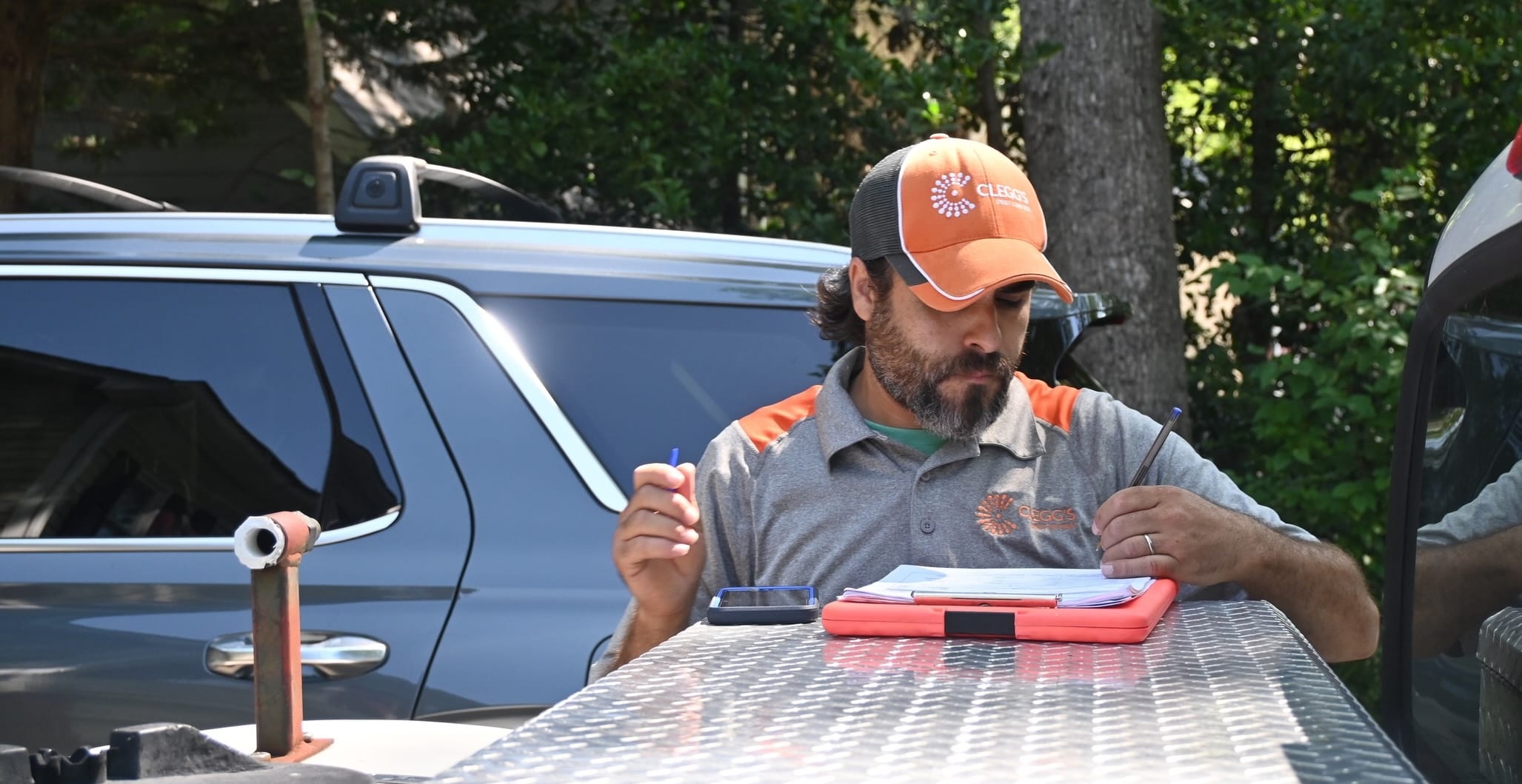
A licensed Clegg's technician working a termite service call in eastern North Carolina.
Full Structural & Crawl-Space Inspection
We walk the exterior foundation line, then go into the crawl space — sills, band joists, piers, subfloor, and insulation — sounding accessible framing and looking for shelter tubes, damaged wood, swarmer wings, and moisture. On slab homes we focus on expansion joints, plumbing penetrations, and the exterior slab edge. You get a plain description of what we found and where.
A Treatment Plan Built for Your Structure
Depending on construction type, activity, and soil conditions, that's a liquid termiticide soil treatment, an in-ground bait station system, or a combination of the two. Crawl-space homes with accessible perimeters often suit a liquid soil barrier; slab homes, hardscaped perimeters, and properties where drilling is impractical often suit baiting. We explain the trade-offs before anything is applied.
Application Adapted to Coastal Plain Soils
NC State Extension describes the standard method as trenching around the foundation and treating to the footing to form a continuous barrier, with drilling and treating through slabs and voids where required by state rule. Greenville's sandy loam over clay and its shallow water table change how product moves through soil, so trench depth, volume, and placement get adjusted on site rather than applied by a fixed recipe. Bait stations, where used, go in the soil around the structure on a set spacing.
We Write Down What We Find
Conducive conditions — grade against siding, a downspout dumping at the footer, standing crawl-space water — get documented with the termite findings, because fixing them is half the job. If you want the background reading first, our termite need-to-know guide covers what to look for between visits.
Call (252) 752-5175Correcting the Conditions That Invited Them
A termite treatment on a soaking-wet crawl space is a treatment you'll be repeating. We address the conducive conditions NC State Extension flags first — soil, mulch, or debris touching wood; water accumulating near the foundation; poorly ventilated damp framing — through grade and drainage corrections, vapor barrier, and crawl-space moisture control. In a county with a seasonal high water table, this step does real work.
Annual Renewal & Monitoring Inspections
Soil treatments and bait systems both need follow-up. Bait stations are checked on a recurring schedule so activity is caught while it's still in the station rather than in your floor joists, and liquid-treated homes get an annual re-inspection of the foundation and crawl space. All work is performed by technicians licensed through the NCDA&CS Structural Pest Control & Pesticides Division. Ask your Greenville technician to walk you through the specific service agreement terms before you sign.
Greenville Neighborhoods & Areas We Serve
Our Greenville office at 864 Rivit Street covers Pitt County and the surrounding eastern NC communities. Technicians who work here every week know which streets sit low, which subdivisions are slab-built, and which neighborhoods still have original crawl-space framing under them.
FAQs About Termite Control in Greenville
Get a Straight Answer About Your Greenville Home
Free termite inspections. Licensed NC technicians. Six decades of eastern North Carolina crawl spaces. Call our Greenville office on Rivit Street.
Call (252) 752-5175 Schedule Online