
Family-owned and protecting Wilmington-area homes since 1964. A board-certified entomologist on staff and termite plans built around how Wilmington homes are actually put together.
Termites don't announce themselves. In a coastal city like Wilmington — warm most of the year, humid nearly all of it, and built on sandy soil that termites move through easily — a colony can work inside a sill plate or a floor joist for a long time before anyone notices a thing. Clegg's Pest Control has served Wilmington homeowners from our office on Enterprise Drive, just off Market Street near Ogden, and has been protecting North Carolina homes since 1964. Rated 4.8 out of 5 stars across thousands of NC reviews, our licensed technicians inspect for termites the way a coastal home requires: crawl space first, moisture second, structure top to bottom.
Whether you own a pre-1900 heart-pine home in the Historic District, a 1950s ranch off Oleander Drive, or a newer slab house in Mayfaire or Porters Neck, a Clegg's termite solutions plan is built around what your specific structure and soil are actually doing — not a checklist someone wrote for the Piedmont. Inspections are free, and if we don't find termites, we'll tell you that plainly.
- Licensed & insured local technicians
- Board-certified entomologist on staff
- Pet- and family-safe treatments
- Free inspection within 24 hours
What Wilmington Homeowners Say About Clegg's
Why Wilmington Has One of NC's Toughest Termite Environments
Subterranean termites need three things: cellulose to eat, soil to travel through, and moisture to survive. New Hanover County hands them all three year-round. Wilmington sits on sandy coastal-plain soils that termites tunnel through far more easily than the heavy red clay of the Piedmont, and the water table sits close enough to the surface that soil under a crawl space rarely dries out completely. Add roughly 58 inches of rain a year — considerably more than Raleigh or Charlotte see — much of it arriving in heavy summer downpours and tropical systems, and the ground around a Wilmington foundation stays damp for long stretches of the calendar.
Temperature is the other half of it. Subterranean termite colonies are active all year, and foraging slows in cold soil rather than stopping. Wilmington's mild winters mean the soil rarely stays cold enough, for long enough, to shut foraging down the way it can farther inland. The practical result: an inland home might get a genuine off-season, while a Wilmington home mostly gets a slower season. That's why coastal inspections lean so heavily on crawl space moisture — controlling water under the house is one of the few levers a homeowner actually controls.
Which Termites Actually Live in Wilmington
Coastal homeowners hear a lot of species names, and some of them get used loosely by companies selling a treatment. Here's the honest picture for New Hanover County — what you're almost certainly dealing with, what you're almost certainly not, and what else a licensed inspector is legally required to look for.
Eastern Subterranean Termite — the one Wilmington homes actually get
This is the termite behind essentially every residential infestation Clegg's treats in the Wilmington area. Colonies live in the soil and reach wood above ground through shelter tubes — those pencil-width mud highways you find running up a crawl space pier or a foundation wall. They need constant contact with moisture, which is exactly why coastal crawl spaces are such productive habitat.
Swarmers are the usual first sign a homeowner notices. Eastern subterranean termites swarm during the daytime, typically in spring, often on a warm day after rain — winged, dark-bodied insects with four equal-length wings that drop off and pile on windowsills. NC State Extension notes that swarming most often follows a warm rain when temperatures pass 70°F and wind is low. A swarm inside the house means a colony is already established in or against the structure.
Formosan Subterranean Termite — not established in New Hanover County
You'll see the "super termite" mentioned in coastal marketing, so it's worth being precise. Formosan subterranean termites are established in parts of the Gulf South and in South Carolina — the first U.S. record was Charleston in 1957 — but North Carolina's documented history is short and specific. NC State Extension records the state's first detection in Brunswick County in 1992, in railroad ties being used as landscaping timbers, with the infested material hauled to a landfill and no termites detected at the residence; the only other NC finds were in Rutherford County, beginning in Spindale in 1994 and again in 1996 and 2002. Extension's summary is blunt: infestations have been found in parts of Rutherford County "but not in any other areas of the state." We're not aware of any authoritative confirmation of an established Formosan population in New Hanover County or the City of Wilmington. If a company tells you your Wilmington home has Formosan termites, ask them to show you the identification.
That said, our inspectors know the differences, because port cities are how this species moves. A Formosan colony can hold well over a million individuals and forage across an area more than 300 feet wide, versus far smaller native colonies — which is where the faster-damage reputation comes from. They can also build carton nests in above-ground voids where moisture is available, rather than relying entirely on soil contact. And their swarm behavior is distinct: Formosan alates fly at dusk, from April through June, while our native swarmers fly in daylight in spring. Soldier heads are oval; native soldier heads are rectangular. If we ever saw those markers on a Wilmington job, it would go straight to NC State's Plant Disease and Insect Clinic for confirmation.
The Other Wood-Destroying Insects on a Coastal Inspection
A termite inspection in North Carolina isn't only about termites. Powderpost beetles are a genuine issue in older Wilmington homes with unfinished heart-pine floor systems and crawl space framing, and damp coastal crawl spaces suit them well. Carpenter ants nest in wood that's already been softened by moisture — a leaking gutter line or a wet band board is a standing invitation. All of these are reportable on North Carolina's official Wood-Destroying Insect Report, which is why we look for them on every inspection rather than only when someone asks.
Where Termites Enter Wilmington Homes
Subterranean termites don't need a hole to get in. They need a path from damp soil to untreated wood — and coastal landscaping, coastal drainage, and coastal construction supply a lot of those paths. These are the conditions our Wilmington technicians flag most often:
Soil-to-Wood Contact
Deck posts, fence rails, porch steps, and lattice buried straight into sandy soil give termites a direct route from the ground into your structure with no barrier crossed.
Crawl Space Piers
Wilmington's high water table keeps crawl space soil damp. Shelter tubes climbing masonry piers toward the sill plate are the classic coastal finding.
Mulch Beds Against Siding
Thick mulch piled over the foundation line holds moisture and hides shelter tubes, letting a colony reach siding and trim entirely out of sight.
Slab Expansion Joints
Newer Wilmington slab homes crack and settle. Expansion joints, plumbing penetrations, and utility conduits are ready-made passages up into the wall framing.
Firewood & Driftwood Piles
Stacked firewood, salvaged driftwood, and leftover landscape timbers resting against the house are food storage — and the first thing we ask homeowners to move.
Gutter & Downspout Runoff
Downspouts dumping at the foundation soak the soil termites travel through and soften the band board they're heading for. Extensions are cheap insurance.
Stumps & Buried Wood
Live oak and pine stumps left after clearing, plus form boards buried during construction, sustain a colony in the yard until it finds the house.
HVAC Condensate & Irrigation
Condensate lines draining at the slab edge and sprinkler heads spraying the foundation create a permanently wet strip exactly where you least want one.
Termite Risk by Wilmington Property Type
Wilmington's housing stock spans more than two centuries, and the age and construction method of your home change both the risk and the right treatment approach. A downtown Italianate and a Porters Neck slab house have almost nothing in common structurally.
Historic District — Pre-1900 Heart-Pine Homes
Wilmington's National Register historic district is one of the largest urban historic districts in the country, and its oldest houses were framed in dense old-growth heart pine and set over shallow, often unimproved crawl spaces. Two things follow. First, that framing is genuinely valuable and genuinely irreplaceable, so damage here isn't just a repair bill — it's a preservation problem. Second, the treatment has to respect the house: brick foundation walls, original mortar, tight crawl clearances, and sometimes historic-district review all shape where we can trench, where we drill, and where a bait station makes more sense than a soil application. Our technicians plan these jobs before they touch a shovel.
Mid-Century Neighborhoods — 1920s–1970s Crawl Space Homes
Forest Hills, laid out in the 1920s as one of Wilmington's first automobile suburbs, and the Winter Park and Sunset Park areas nearby, hold the city's deepest concentration of mature crawl space houses — bungalows, Cape Cods, and 1950s ranches under a heavy live oak canopy. The risk profile here is quiet and cumulative: original chemical soil barriers from decades ago are long gone, decades of settled landscaping have raised grade against siding, mature roots have shifted drainage, and shade keeps crawl spaces from ever drying out. These are the homes where a routine inspection most often turns up active tubes the owner never suspected.
Slab-on-Grade Construction — Newer East and North Wilmington
Slab construction removes the crawl space, which removes the easiest place to find termites early. That's the trade-off. On a slab home the colony reaches framing through expansion joints, plumbing and conduit penetrations, or the edge of the slab hidden behind brick veneer and mulch — and the first visible evidence is often inside, along a baseboard, rather than under the house. Many of these neighborhoods were built on cleared woodland where stumps and root systems remain in the soil. Pre-construction soil treatments also weaken over time, so a house that's fifteen or twenty years past its build date should not be assumed protected.
Raised & Pier Coastal Construction
Raised homes on piles and piers near the waterway are built for flood clearance, and the open underside genuinely helps — good airflow is not a termite's preferred environment. The vulnerability is different: every pile is an individual soil-to-wood pathway, and salt air, blowing sand, and wind-driven rain steadily weather the structural wood at the connections. Storage rooms, enclosed stair towers, and ground-level utility closets built in under the house re-create exactly the enclosed, humid, wood-to-ground conditions the elevation was supposed to eliminate. On these properties we inspect every pile individually and pay close attention to anything framed in below the flood line.
Wilmington's Termite Season: What to Expect
"Termite season" is really swarm season — the few weeks a year colonies become visible. The colonies themselves work continuously, and along the coast the warm months on either end of the calendar stretch the active window well past what an inland homeowner would expect.
Protecting Wilmington Homes from Termites Since 1964
60+ years of North Carolina termite work. 250,000+ customers served. Free inspections — response within 24 hours.
Call (910) 796-1202 Schedule OnlineHow Clegg's Treats Termites in Wilmington
There's no single termite treatment that fits every coastal home, and anyone who quotes you one before looking under the house is guessing. Here's how a Clegg's termite job actually runs in Wilmington, start to finish.

A Clegg's technician working through an interior termite and wood-destroying insect inspection.
Full Structural & Crawl Space Inspection
Your technician goes under the house — not just around it. We check piers, sill plates, band boards, and floor joists for shelter tubes and damaged wood, sound suspect framing, and note every conducive condition: standing water, grade against siding, wood debris, blocked vents, plumbing leaks. On slab homes we work the perimeter, expansion joints, penetrations, and interior baseboards instead. You get findings explained on-site, not a form left in the door.
A Treatment Plan Built for Your Structure
From what we find, we recommend a liquid termiticide soil treatment, a bait and monitoring station system, or a combination — the choice depends on your foundation type, soil conditions, access, and whether activity is currently present. Historic downtown homes with fragile masonry and tight crawl clearances often call for a different approach than an open Ogden slab. We walk you through what we're proposing and why before anything is scheduled. See what you need to know about termite treatment for more on how the options differ.
Application — Trenching, Drilling, or Station Placement
Liquid soil treatments are applied by trenching along the foundation and, where slabs, patios, or driveways sit against the structure, by drilling and treating beneath them so the treated zone stays continuous. Bait systems are installed in the soil around the structure on a measured spacing. All applications follow product labeling and NCDA&CS Structural Pest Control requirements, performed by licensed technicians.
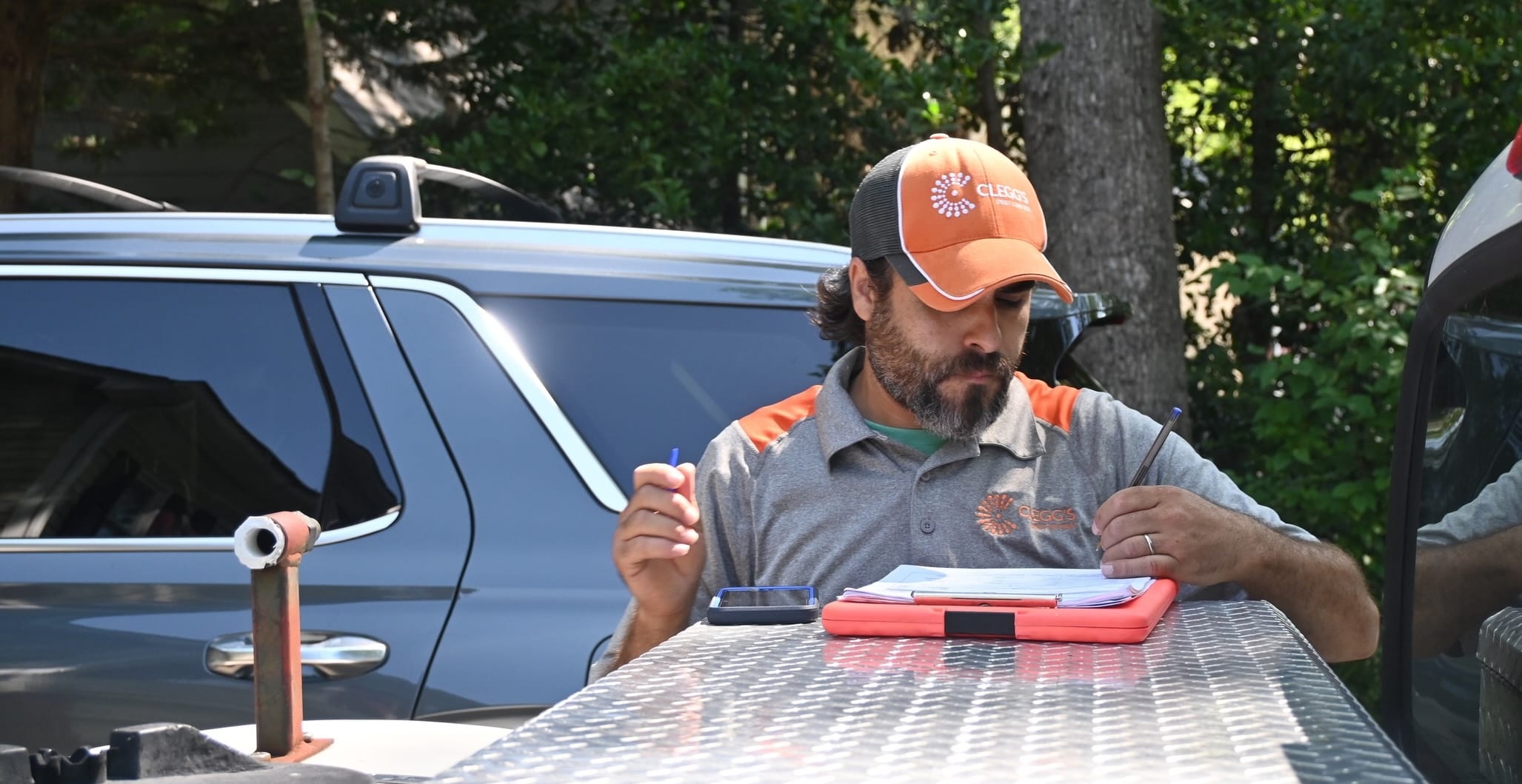
Findings You Can Actually Read
Every Wilmington inspection is documented — where activity was found, which conditions are feeding it, and what we recommend in what order. If you're preparing to sell, that documentation is also the groundwork for a clean wood-destroying insect report.
Call (910) 796-1202Correcting the Moisture — Especially on the Coast
This is the step most often skipped, and on a Wilmington home it may matter more than the chemistry. Termites need moisture, and a wet crawl space keeps handing it to them. Depending on what we find, that means vapor barriers, ventilation or dehumidification, drainage and grading corrections, downspout extensions, and repairing plumbing leaks. Clegg's handles this work directly through our moisture control services — a dry crawl space is a far less hospitable place for termites, beetles, and carpenter ants alike.
Annual Renewal & Monitoring Inspections
Termite protection isn't one visit. Soil treatments break down over time and bait stations need servicing, so ongoing protection runs on an annual renewal with periodic re-inspection — which is also how new activity gets caught early rather than after the damage is done. NC State Extension makes the same point: periodic inspection is the most important thing protecting a structure. Ask your technician exactly what your renewal and inspection schedule includes before you sign anything.
Wilmington Neighborhoods & Areas We Serve
Our Wilmington office on Enterprise Drive covers the city and the surrounding New Hanover County communities. Our technicians know how construction type changes from one part of town to the next — and they inspect accordingly. Learn more about termite biology and behavior if you want the background before we come out.
FAQs About Termite Control in Wilmington
Get a Straight Answer About Your Wilmington Home
Free termite inspections across New Hanover County. Same-day emergency response available. Call our Wilmington office on Enterprise Drive.
Call (910) 796-1202 Schedule Online