
Family-owned and protecting Greenville-area homes since 1964. Licensed, pet-friendly technicians who know exactly where Greenville mosquitoes breed — and how to stop them at the source.
Greenville sits on the NC Coastal Plain — flat terrain, slow-draining soils, and the Tar River running straight through the heart of the city — which makes it one of the most mosquito-intense environments in the entire Southeast. The Tar River floodplain, Swift Creek, the Contentnea Creek corridor to the north, and dozens of HOA retention ponds throughout south and east Greenville create an almost unbroken chain of mosquito breeding habitat that runs directly into residential neighborhoods. Clegg's Pest Control has served Greenville homeowners from our office on Rivit Street for over 60 years. Rated 4.8 out of 5 stars across more than 2,200 NC reviews, our licensed technicians know Pitt County's specific mosquito pressures — when populations spike after a Tar River rain event, which ECU-area neighborhoods battle Asian Tiger Mosquitoes all summer long, and which treatment approach stops them at the source.
Whether your yard backs up to the Tar River Greenway in Jarvis Landing, you live near one of Foxcroft's HOA retention ponds, or you're renting a bungalow in College Hill, a customized Clegg's mosquito control treatment plan significantly reduces populations so you can actually enjoy your outdoor space. We serve every Greenville neighborhood — from Uptown along the riverfront down to Stantonsburg Road in east Greenville — and the surrounding Pitt County communities of Winterville, Ayden, and Grifton.
- Licensed & insured local technicians
- Board-certified entomologist on staff
- Pet- and family-safe treatments
- Free inspection within 24 hours
What Greenville Homeowners Say About Clegg's
Why Greenville Has One of the Worst Mosquito Problems in NC
Greenville's geography stacks every mosquito advantage in the insects' favor. The city occupies the NC Coastal Plain — a low-gradient landscape where water simply doesn't drain the way it does in Piedmont cities like Raleigh or in the mountains to the west. When it rains in Greenville, water pools in yards, fills neighborhood swales, and backs up in ditches that may stay full for days. The Tar River — a slow-moving lowland river with a broad floodplain — runs directly through downtown and established residential areas, creating one of the largest continuous mosquito breeding zones in eastern NC. Pitt County averages over 50 inches of annual rainfall, and summer dewpoints regularly hit 70°F or higher — conditions that compress the entire mosquito life cycle and accelerate population growth dramatically.
The Greenville Greenway system compounds the problem by following the Tar River and Swift Creek corridors directly through the city. Shaded floodplain vegetation, naturally pooling soil, and persistent moisture make these corridors prime habitat — and adult mosquitoes travel 300–600 feet from breeding sources, pulling residents in adjacent neighborhoods into the pressure zone. The Pitt County Health Department monitors mosquito-borne disease activity annually, but county resources focus on public spaces. Private residential properties in Greenville are yours to manage — and the flat Coastal Plain means the burden is real. That's where Clegg's comes in.
Where Mosquitoes Breed Around Greenville Homes
Mosquitoes need as little as a bottle cap of standing water to complete a breeding cycle. In Greenville's flat Coastal Plain environment, standing water isn't a rarity after a rainstorm — it's the default. Here are the most common mosquito breeding sources on and around Greenville properties:
Tar River Floodplain
After any significant rain event, the Tar River floodplain pools across a wide corridor through downtown and residential areas — creating massive temporary breeding habitat that replenishes all season long.
HOA Retention Ponds
Virtually every south and east Greenville subdivision includes one or more retention ponds. The flat terrain means these ponds hold water indefinitely, and their shallow, vegetated edges breed Southern House Mosquitoes continuously.
Yard Ponding & Swales
Coastal Plain lawns pond after almost any rain event. Low spots, yard depressions, neighborhood drainage swales, and roadside ditches stay wet for days — an ideal environment for larvae to develop before anyone notices.
Creek & Greenway Corridors
Swift Creek in west Greenville and the Contentnea Creek corridor to the north both run through wooded floodplain that stays cool, shaded, and persistently moist — perfect resting and breeding habitat for multiple species.
Tree Cavities & Leaf Debris
College Hill's mature tree canopy creates cool microhabitats and bark cavities that collect water. Asian Tiger Mosquitoes — Greenville's most aggressive daytime biters — breed readily in these small volumes.
Clogged Gutters
Greenville's hardwood canopy drops leaves year-round. Gutters that go uncleaned become standing-water incubators by early spring — one of the most overlooked and most productive breeding sites on any property.
Yard Containers
Flower pots, buckets, toys, tarps, and birdbaths. Asian Tiger Mosquitoes are container specialists and breed aggressively in student-dense neighborhoods where items accumulate outdoors and go unmoved for weeks.
HVAC Condensate Drainage
Greenville's extreme summer humidity means central AC units work overtime and drain continuously. Condensate discharge lines that pool near the foundation are a hidden but consistent mosquito source throughout the season.
Mosquito Pressure by Greenville Property Type
Mosquito intensity in Greenville is shaped heavily by your proximity to the Tar River, your neighborhood's drainage infrastructure, and the age of your surrounding landscape. Here's what residents of different property types typically experience — and how Clegg's addresses each situation.
Tar River Floodplain & Greenway-Adjacent Homes
Homes located directly on or near the Tar River floodplain face the most intense mosquito pressure in Pitt County. Major rain events — common in Greenville's wet coastal climate — flood the floodplain and leave broad sheets of standing water that dry slowly on flat terrain. These temporary pools produce enormous numbers of floodwater mosquitoes within days of a rain event. The Tar River Trail runs through this corridor, meaning there is no meaningful buffer between floodplain breeding habitat and residential yards. Residents in Jarvis Landing and along the downtown riverfront area typically need recurring monthly treatments throughout the season, with special attention to the property line facing the floodplain.
HOA Communities with Drainage Ponds
Virtually every planned community built in south and east Greenville over the past three decades includes multiple engineered retention ponds. On flat Coastal Plain terrain, these ponds don't drain and don't dry — they hold water year-round. Their shallow margins, often planted with ornamental grasses or natural vegetation, are ideal nursery habitat for the Southern House Mosquito. Homes within 200–300 feet of an HOA retention pond — which describes most of Foxcroft, Ironwood, and similar developments — typically experience some of the highest mosquito counts in the city. Clegg's can treat pond edges directly as part of your seasonal service plan.
ECU Area / College Hill Neighborhoods
College Hill and the streets surrounding East Carolina University present a distinct mosquito challenge. The neighborhood features older housing stock with mature tree canopy — ideal conditions for Asian Tiger Mosquitoes (Aedes albopictus), which breed in tiny water-holding containers and tree cavities and bite aggressively during daylight hours. High residential density, transient student populations, and the accumulation of outdoor items (potted plants, coolers, buckets) between moves creates an abundance of small container breeding sites that go unaddressed. The academic calendar also means outdoor gatherings — tailgates, porch parties, and ECU events — are happening precisely when mosquito pressure peaks in late summer and early fall. Foliage barrier treatments targeting resting vegetation, combined with container-source education, deliver the most meaningful results in this part of Greenville.
Winterville, Ayden & Pitt County Suburban Growth Areas
Newer residential development on the fringes of Greenville — in Winterville, Ayden, and communities along the Contentnea Creek corridor near Grifton — faces a particular variety of mosquito pressure. Former agricultural land converted to subdivisions often has heavy clay soils, fresh grading that disrupts natural drainage, and improperly sloped lots that create unintended ponding. New HOA ponds installed for stormwater compliance frequently lack aeration systems, making their edges highly productive breeding zones. The Contentnea Creek corridor itself is a large wetland system that stays active late into the fall season, extending the effective mosquito season for residents near Grifton. Early-season treatment before populations establish, combined with ongoing larval source management, is the most cost-effective strategy for these newer communities.
Greenville's Mosquito Season: What to Expect
Greenville's long, hot, and humid seasons push the mosquito calendar to its limits. The Coastal Plain climate — warmer springs and falls than Piedmont NC, combined with higher humidity and more persistent standing water — means Greenville residents deal with arguably the most intense and extended mosquito season in the state.
Greenville's Most Trusted Mosquito Control Since 1964
60+ years protecting NC homes. 250,000+ customers served. Free inspections — response within 24 hours.
Call (252) 752-5175 Schedule OnlineHow Clegg's Controls Mosquitoes in Greenville
Effective mosquito control in Greenville requires a strategy built around the Coastal Plain's unique conditions — persistent standing water, floodplain proximity, and the full-season intensity of a southeastern lowland climate. Clegg's targets both adult mosquitoes and the breeding sources that replenish populations after every rain event. Here's what a Clegg's treatment looks like from start to finish:

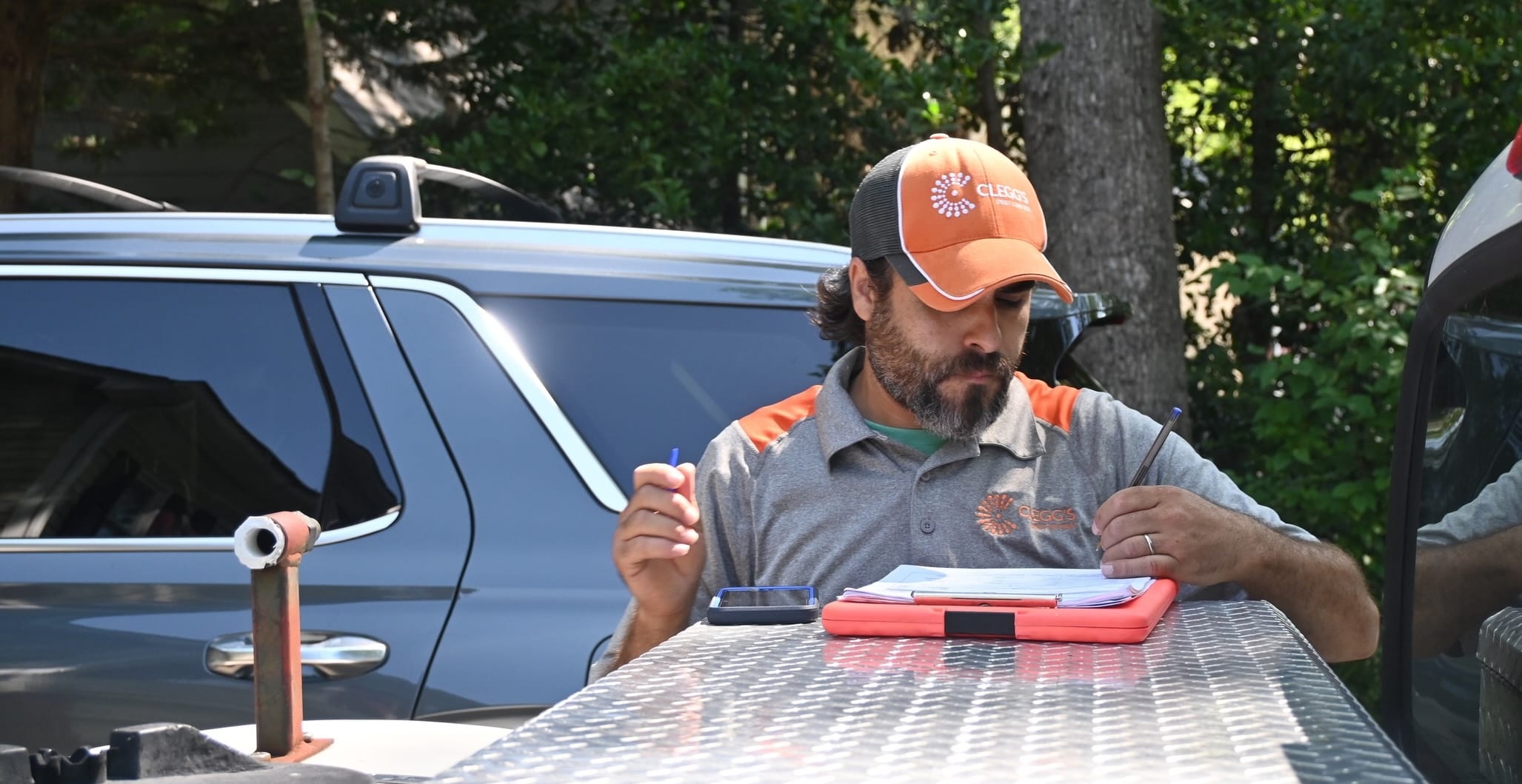
A Clegg's technician treating a Greenville home for mosquitoes and general pest activity.
Property Inspection
Your Clegg's technician walks the property to identify active breeding sites specific to Greenville's environment — Tar River floodplain proximity, low-lying yard ponding areas, HOA pond edges, clogged gutters, container sources, tree cavities, and greenway adjacency. We map the high-risk zones on your lot before applying any treatment so nothing gets missed.
Vegetation Barrier Treatment
Adult mosquitoes rest in shaded vegetation — shrubs, groundcover, ornamental grasses, and tree understory — during the heat of the day. Greenville's humidity means this resting habitat is dense and widespread. We apply a fine mist treatment to these resting sites, eliminating adults present and providing residual protection for 3–4 weeks.
Larval Source Control
Where standing water can't be eliminated — HOA pond edges, floodplain margins, roadside ditches, drainage swales — Clegg's applies larvicide that targets mosquito larvae before they develop into adults. This is especially important for pond-adjacent properties in Foxcroft, Ironwood, and floodplain-adjacent lots near Jarvis Landing, where water is a permanent feature of the landscape.
Treatment Plans Built Around Your Property's Specific Conditions
A floodplain lot near the Tar River Greenway needs a fundamentally different plan than a College Hill bungalow with container-breeding Tiger Mosquitoes, or a Foxcroft home within 150 feet of an HOA retention pond. Our Greenville technicians document your specific situation and build a treatment program around it — not a generic spray schedule that looks the same on every property.
Call (252) 752-5175Recurring Monthly Service
A single treatment lasts 3–4 weeks. Because Greenville's summer storms are frequent and the Coastal Plain's flat terrain means breeding sites refill almost immediately, recurring monthly service from April through October is what maintains meaningful population reduction. One-time treatments offer temporary relief; a full-season plan built around Greenville's actual mosquito drivers actually solves the problem.
Pet- and Family-Safe Products
Clegg's treatments are safe for children and pets once the application has dried — typically 30–45 minutes after treatment. Our technicians follow all NC Department of Agriculture licensing and application guidelines. If you have specific sensitivities or product preferences, let your technician know before the visit and we'll accommodate them.
Greenville Neighborhoods & Areas We Serve
Clegg's provides mosquito control services throughout Greenville and the surrounding Pitt County communities. Our Greenville technicians understand the specific mosquito pressures in each part of the city — from the Tar River floodplain neighborhoods along the greenway to ECU-area streets battling container-breeding Tiger Mosquitoes to the newer HOA communities of south and east Greenville.
FAQs About Mosquito Control in Greenville
Ready to Take Back Your Greenville Yard?
Free inspections. Same-day emergency response available. No long-term contracts required. Call our Greenville office on Rivit Street today.
Call (252) 752-5175 Schedule Online